


The Gothic Altarpieces
That was when I saw the Pendulum. The sphere, suspended at the end of a long thread attached to the choir vault, traced its sweeping oscillations with isochronous majesty.
Umberto Eco (Foucault’s Pendulum)
It is interesting to study the construction of the polygons that form the apses. In many monuments, you will notice that the diagonal of the choir’s last bay directly determines the angle of the polygon. By virtue of its design and the choice of an initial proportion, the final layout is predetermined. For those who might have doubts, they will notice that Villard de Honnecourt drew these lines in a single stroke (Fig. 1),
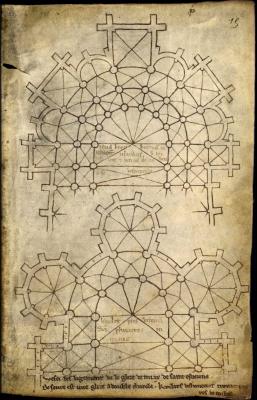
Fig. 1 – Plans of apses (Villard de Honnecourt – folio 29) D.P.
I have developed various methods for drawing this type of layout. Here is one that is particularly interesting (Fig. 2). On the last bay of the choir, we define a square whose diagonal is equal to half the width of the nave (as indicated by the dotted arc).
The height of this square allows us to trace the boundary of the apse. At the upper corners of the rectangle thus formed, I mark the pillars and draw the semicircle of the apse with center O. From the lower corners, I then draw two lines that intersect at O, defining two additional pillars where they intersect the circle.
The distance between the pillars we have just defined determines two of the sides we are looking for. It will therefore suffice to extend them symmetrically to complete the division of the circle.

Fig. 2 – Division of an apse into five parts
The method we have just examined governs the layout of the last bay of the choir and the apse of many Gothic buildings. It can be found in Reims, as well as at the Abbey of Saint-Martin-aux-Bois and the Royal Collegiate Church of Saint-Quentin.
As for apses crowned by seven chapels (Fig. 3), their construction follows the same principle. The width of the central nave is divided into three parts, allowing a rectangle measuring three by one to be drawn inside the apse. The intersection of the diagonals (point O) serves as the origin of the circles, while their extensions define the starting angle and determine the position of the columns.

Fig. 3 – Division of an apse into seven parts
Since half the length of the line segment is equal to the value that must be transferred to the circle to form the angles, nothing could be simpler than drawing the pseudo-heptagon. These are, in fact, 1-by-2 triangles arranged in a fan shape. This method can be found, among other places, in Beauvais and Amiens.
These two apse designs are generic systems. It should be noted that some cathedrals have their own unique layouts, such as Chartres.
The Abbey Church of Saint-Martin-aux-Bois in the Oise department will allow me to illustrate this point (Fig. 4). The building features a nave without a transept, enclosed by an apse similar to that of Reims.

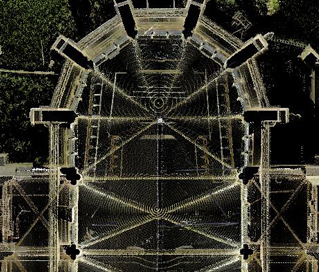
We have just seen that the side of the square determines the width of the last bay, while its diagonal is equal to half the length of that same bay. To determine the height of the nave bays, the architect simply used this half-width to form equilateral triangles. There are therefore two per bay. This segment (the red lines) is common to the entire building. It alone explains its harmonious balance.
In this example, it is difficult to tell where the layout of the choir begins and that of the nave ends. Here, they share the same fundamental nature. You can view the laser scan of this building on the website saint-martin-aux-bois.org
Outlines of the apses at Mont Saint-Michel Abbey and Notre-Dame d’Évreux
In the documentary “Mont-Saint-Michel — The Archangel’s Labyrinth,” at 1h 15' 52'', Yves Gallet, a professor of medieval art history, highlights a correspondence in proportions between the apse of this abbey and that of Évreux Cathedral. He also notes that the choir piers are clad over Romanesque supports, just like the columns in the crypt. It is clear that the architect was compelled to follow a preexisting Romanesque pattern.
This raises a question: since the layout of the apse at Troyes Cathedral is similar to that of Le Mont, might it itself be a reflection of a Romanesque design principle? The history of Notre-Dame d’Évreux seems to refute this hypothesis. According to Philippe Gavet, the former Romanesque cathedral of Évreux is more similar to the Abbey Church of the Trinity in Caen, which features an apse divided into five sections rather than seven. However, this detail alone cannot rule out the hypothesis.
In terms of geometric layout, the segmentation of the chevet at Évreux and at Le Mont is the simplest imaginable. The width of the nave is divided into seven parts, seven units. The semicircle of the choir is positioned one unit away. Starting from one of the boundaries of this same choir, an arc with a radius of two units, an arc equal to half the width of the nave, and an arc equal to five units are then drawn. By intersecting the semicircle, these arcs determine the exact centers of the piers.
As one might imagine, the segmentation obtained by this process is not regular, but the exact same spacing is observed on the plans.

Jean Pierre Bourcier, a specialist in technical drawing and stereotomy, verified my geometric demonstrations from a numerical perspective. Here I present his analyses and opinions on the constructions we have just examined.
Analysis of the drawing in Figure 2 (created in AutoCAD)
“Let (A,B) be the width of the nave and (U,V) its axis. From point B, draw line (B,M) such that angle (A,B,M) is equal to 45°. Draw a circular arc with radius (B,U) and center at B. It intersects (B,M) at I. From I, draw the line (D,C) parallel to (A,B). This line defines the boundary of the choir.
Let O be the midpoint of (D,C); draw the line (O,B). It intersects the semicircle of radius (O,D) at P, which is the center of the second pier, with D being the position of the first pier. To find the centers of the other piers, simply extend the chord (D,P) to (P,Q) and then to (Q,R). We then observe that the chord QT is longer than the chord DP.
If we use point P and its symmetric point W as a reference—point Q and its symmetric point T being defined by extending the chord (D,P)—then the chord (Q,T) is longer than the other four.
Let DP = CW = WT = PQ, with QT > DP. For a nave 12 m wide, this gives DP = 3634.87 and QT = 4000, whereas the side length of the decagon inscribed in the circle with radius OD is 3708.3
If we consider point T, the deviation between this outline and that of the theoretical decagon is 145.33 mm along an axis perpendicular to the nave’s axis and 49.48 mm along an axis parallel to the nave’s axis; since the center of the pier remains on the circle of radius OD, given the pier’s design and the measuring instruments used at the time, the deviation is entirely acceptable. »

Analysis of the drawing in Figure 3:
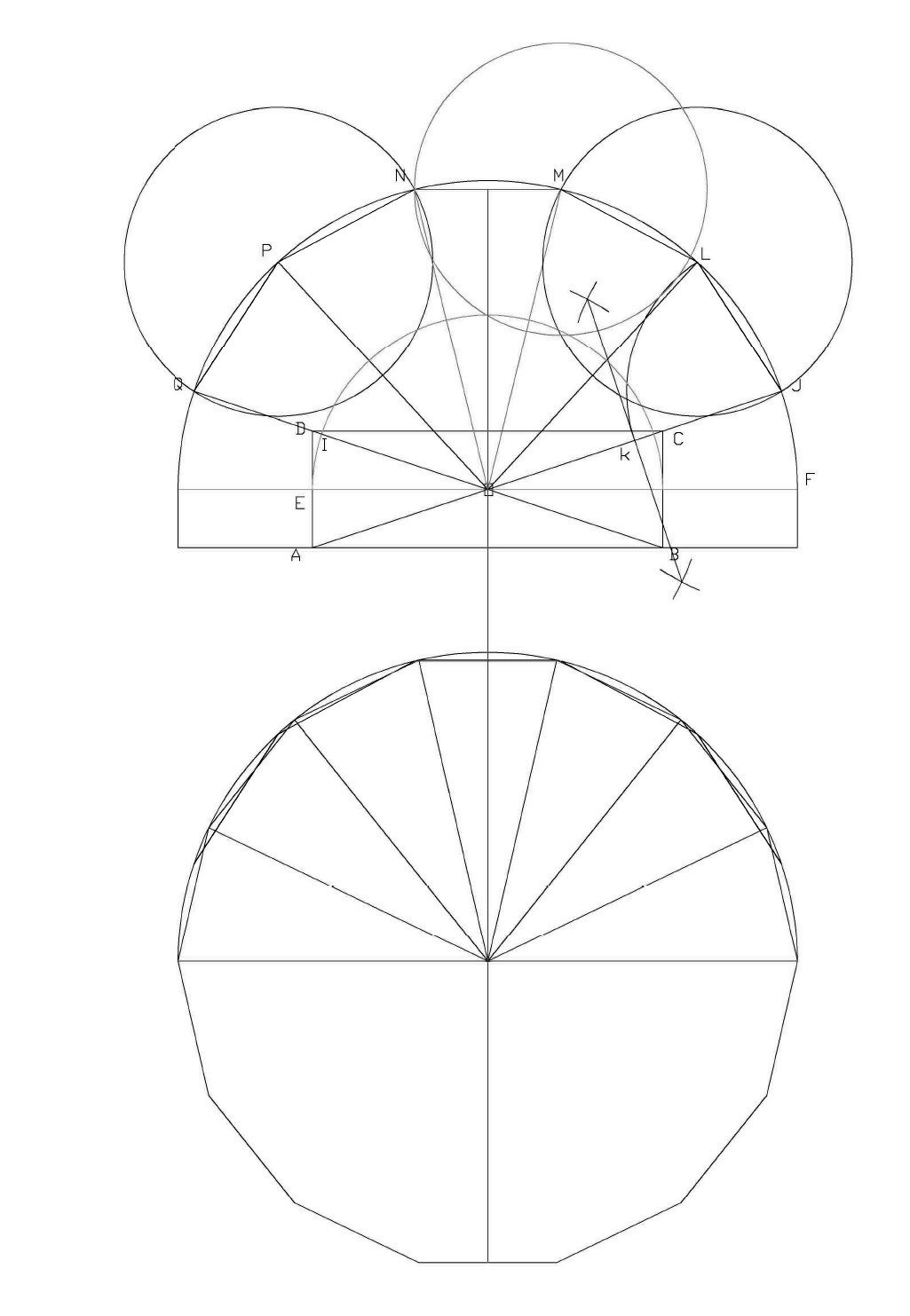
“Let AB be the width of the nave and UV its axis. AB is divided into three equal parts. The rectangle ABCD, with a short side of AB/3, is drawn. The two diagonals are drawn; their intersection, point O, is the center of the circular axes of the piers. This point O is also the point of intersection of the radial axes of the piers.
Let the circle with radius OE be drawn; the center of the first pier will be its point of intersection I with the diagonal OD.
Next, draw the centers of the piers located on the circle with radius OF. Extend the diagonal OC; its intersection with the circle of radius OF defines the center of the first stack at J.
Let K be the midpoint of OJ; and the segment JK is the chord to be transferred to the circle of radius OF to obtain the points L and M, the centers of the next two piers: JL = JK and LM = OJ/2.
By symmetry with respect to the nave axis, we define the points N, P, and Q as the centers of the following piers. The intersection of the rays originating at O and passing through the centers of the piers on the circle of radius OF with the circle of radius OE defines the centers of the piers belonging to that circle.
We then observe that JL = LM = NP = PQ, with MN < JL, which yields, for a nave 12 m wide and OF = 10616 (arbitrary value), JL = 5,308 and MN = 5,012.34, since the side length of the regular 14-sided polygon inscribed in the circle of radius OF is 4,724.56
. If we consider point M, the deviation between this outline and the outline of the regular 14-sided polygon inscribed in the circle of radius OF is 143.9 mm along an axis perpendicular to the nave’s axis and 33.9 mm along an axis parallel to the nave’s axis; since the center of the pier remains on the circle of radius OF, given the accuracy of the pier and the measuring instruments used at the time, this is entirely acceptable.”
Comments

David Orbach (Architecte - Ingénieur structure - Enseignant à l’Université Populaire de Caen de Michel Onfray)

Jean-Michel Mathonière - Directeur éditorial chez Éditions Dervy - Historien des compagnonnages

Cathédraloscope

Site : lescathedrales.wordpress.com

Jean-Pierre Bourcier - Spécialiste du trait

Olivier Petit - Médiéviste

Jean-François Lecompte - écrivain

Luciano Xavier - Maquettiste en cathédrales gothiques

Arcana Les Mystères du Monde - Youtubeur (Chaine Arcana)

troph38

Jean-François Lecompte - écrivain
John Brown

Armand Priest (ESTP) - Commentaire Facebook

Anthony CRESTIN - La géométrie et le mythe

Joël Supéry

Asso Fermat-Science

M. Moldovan

Catherine Leschenne


Dominique Gury