


On this page, I focus on the essentials: highlighting the principle of segments and the triple-enclosure system in an iconic Gothic monument.
Amiens: The Reconstructed Floor Plan
“Mankind has never conceived of anything important that it has not carved in stone.”
Victor Hugo

Plan of Amiens Cathedral - Credit: Gothika - CC-BY-SA

Fig. 2a - Drawing of segment A

Fig. 2b - Drawing of segment B
At first glance, this construction may seem curious or arbitrary, but recall the method used to partition a Gothic apse. It required drawing a rectangle composed of three squares. Since the base of the apse is equal to the width of the Table, there is no need to make a further division (Fig. 3). It suffices to retain and extend the existing lines to draw segment B in a single stroke (the same drawing principle is found in Chartres).
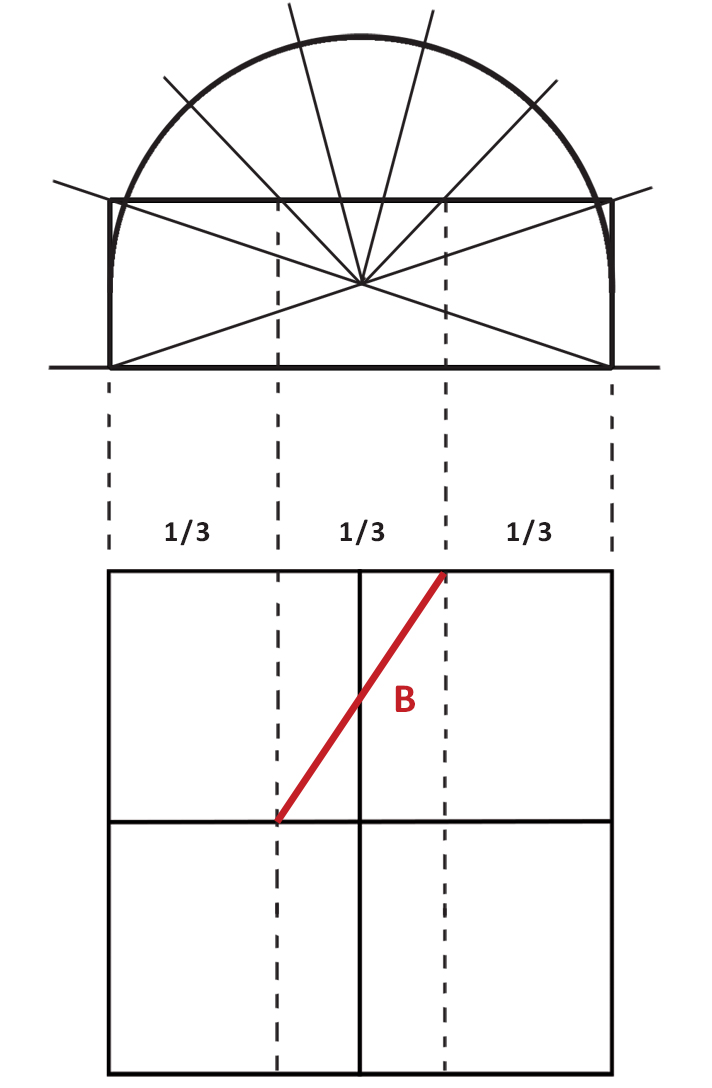
Fig. 3 - Unified layout of the apse and the Table of Amiens
This leaves the green segment, which is determined here by half the height of the Table. The length of the transept, meanwhile, is obtained by transferring segment C three times.


Figure 6 shows the layout of the three enclosures with their natural extensions and respective proportions. The angle that divides the apse corresponds to the diagonal of a rectangle, as explained earlier. The blue segment is equal to 3 times the green segment.
Only five lines (dotted) have been added to mark the intermediate bays. They are equidistant, determined by the green segment, so it was very easy to draw them. Note that the sixth bay of the nave is wider than the others. This element is not shown in the drawing. Figure 7 completes the reconstruction by drawing pillars at each intersection of lines and buttresses where the lines cross outside the outline. Figure 8 shows the floor plan of Amiens Cathedral.


Figs. 6, 7, 8 - The Amiens Cathedral redrawn (excluding the western massif and apsidioles)
Based on the basic outline of the triple enclosure, segments are added to give the building its characteristic Latin cross shape—a figure in which one arm is longer than the other. However, this shape is merely a symbol which, while it affects the building’s footprint, has no bearing on the sacred proportions of the sanctuary defined by the triple enclosure. I explain this in the book. You will also find a reconstruction of Chartres Cathedral, including a floor plan and elevation.
Comments

David Orbach (Architecte - Ingénieur structure - Enseignant à l’Université Populaire de Caen de Michel Onfray)

Jean-Michel Mathonière - Directeur éditorial chez Éditions Dervy - Historien des compagnonnages

Cathédraloscope

Site : lescathedrales.wordpress.com

Jean-Pierre Bourcier - Spécialiste du trait

Olivier Petit - Médiéviste

Jean-François Lecompte - écrivain

Luciano Xavier - Maquettiste en cathédrales gothiques

Arcana Les Mystères du Monde - Youtubeur (Chaine Arcana)

troph38

Jean-François Lecompte - écrivain
John Brown

Armand Priest (ESTP) - Commentaire Facebook

Anthony CRESTIN - La géométrie et le mythe

Joël Supéry

Asso Fermat-Science

M. Moldovan

Catherine Leschenne


Dominique Gury