


Results
“There are more things in heaven and earth, Horatio, than are dreamt of in your philosophy.”
Hamlet, William Shakespeare
I have one final point to make regarding the validity of this work. Aside from any errors on my part, it is possible that future analyses based on strict metric measurements may cast doubt on the legitimacy of a particular design.
However, it must be understood that if a method is common to a large number of buildings, it cannot be dismissed simply on the grounds of mathematical precision. Let me explain: in all the examples, the geometric principles are identical. Simple shapes form a polygon onto which a fraction of the base is sometimes projected to construct a triangle with proportions of 2/3, 2/5, 3/4, 3/5, or 3/4/5.
This method can be seen in the profile of the Priory of Saint-Leu-d’Esserent, built using an equilateral triangle topped by a 2/5 projection; in that of Amiens Cathedral, whose profile consists of a long square surmounted bya 30° triangle and the structure of two equilateral triangles and a 1/2 offset, in Troyes Cathedral, built upon two equilateral triangles, or in all the other Gothic monuments I have had the opportunity to study. An investigator would call this an “overwhelming amount of evidence.”
This is why a numerical discrepancy is highly likely to reveal a break in construction methods, a change in the chief architect, a modification to the design, or one of the many accidents that have punctuated the long history of these monuments. For example, many cathedrals have undergone floor restoration work, which automatically results in a change in the height under the vaults. According to Professor Andrew Tallon, the floor of Bourges Cathedral was originally thirty centimeters below its current level.
Furthermore, I have observed that the floor level is not always uniform within the cathedral. There can be significant differences between the side aisles and the central nave, or between the nave and the choir. Beauvais is a perfect illustration of this (see Figure 1). Thus, the geometric design may or may not be evident depending on the specific location. Let us not forget that the builders’ intention was not to highlight these layouts, which were secret by nature. For them, they served as guides and aids to the design process. It is even reasonable to assume that, over the years, certain liberties may have been taken with these formal models, with the geometric constructions becoming merely indicative.

Fig. 1 - East-west section of the eastern part of Beauvais Cathedral - Credit: Cyark
We should also take into account the fact that the master builder designed the elevation before the paving was completed; yet this final stage involves earthwork and therefore variations in elevation. Added to this are the margins of error inherent in any medieval construction site...
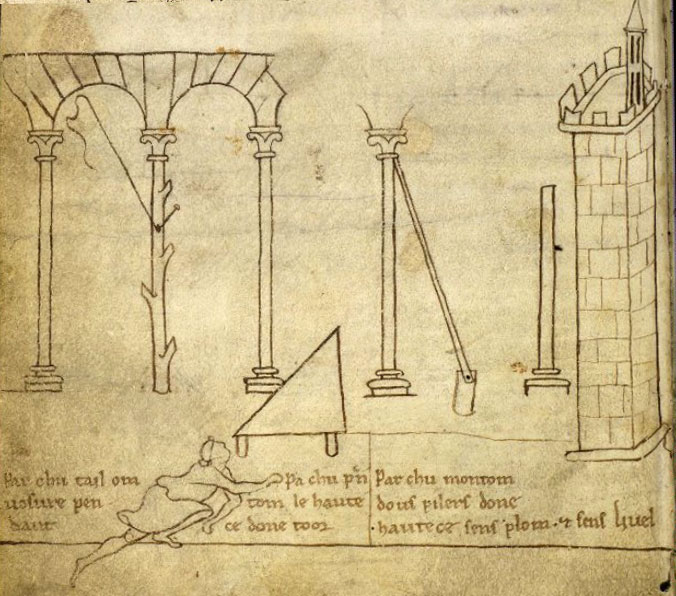
Let’s assume that this method of measurement was among the most precise ;)
In light of these factors, it makes sense to set formal precision aside and focus instead on the Gothic concept—the recurring geometric motifs of these buildings.
That said, one major question remains. Do the geometric layouts, the segments of the Table, and the principle of the three enclosures apply successfully to all cathedrals? The answer is both simple and complex. As far as the layouts are concerned, the answer is clearly yes. However, while the elevation layouts and the principle of the three enclosures are universal, the use of segments in the Table is not. Constrained by sexpartite vaults, the earliest cathedrals retain simple layouts. In this context, the segment system—which aims to simplify their design—is unnecessary. Conversely, the oblong-plan cathedrals of the so-called “classical” period feature segments defined according to common methods. They arose from a practical necessity and a symbolic need. It was necessary to be able to build simply, using complex rhythms, within a common unity.
These secrets would not survive the fall of the Temple in 1307, the Hundred Years’ War, or the Great Plague of 1349—events that marked the decline of the Gothic style and the disappearance of its secrets. It was the end of an era. The 14th century was a period in which the enthusiasm and creativity of previous centuries were irrevocably shattered. Faith, the foundation of creation, became a constraint, and free thought vanished beneath formalism.
Gothic art had no concept of “art for art’s sake.” Its beauty lay in a perfect harmony between the work and its purpose. In the decades that followed, the technical skill of craftsmen and sculptors would reach new heights. But this very virtuosity, marred by exuberance and excess, would strip the buildings of all unity. This architectural expression needed a guiding framework, a moral and technical “authority,” to prevent it from straying off course. That framework had vanished. We remember the Cathedral of Beauvais, whose arrogant spire caused its collapse (1573). The spire had been imposed by the bishop even though the nave had not yet been built. In other times, such folly could never have occurred. Mostly laypeople, the architects were no longer connected to the abbeys, nor steeped in the mystique of the “Trait.” They had forgotten the Gothic ideal. They could not pass on its secrets.
Seeking the geometric relationships common to the Gothic style was a challenge. In theory, the proportions should be obtainable through simple, traditional geometric relationships. That is indeed the case here. I have identified a method, a geometric vocabulary—in fact, a complete system of Gothic design—that can be summarized in a few figures. First, the circle, the matrix of all regular polygons. Next come the triangles, primarily the equilateral triangle, the so-called Pythagorean triangle, as well as triangles with proportions of 2/3, 2/5, and 3/5. And finally, we have the square. It is astonishing to realize that these shapes alone are sufficient to define the elevation of Gothic cathedrals.
There are four DNA bases, yet the entire universe would not be vast enough to contain the various genes created by their combinations. Thanks to these four polygons, we can determine the proportions of all existing cathedrals and those that might have been built.
It is clear that these shapes and the structures that organize them—the triple-enclosure system, the division of spaces into thirds, the dual system of tracery, and the construction of the apses—together form the true signature of Gothic cathedrals.
It was no easy task to rediscover these secrets, but my admiration goes to those who discovered these magical proportions—the creator or creators of these master plans. They developed a system that was easy to teach and memorize, enabling the rapid spread of the Gothic style.
Incidentally, this answers the age-old question of how it was possible to find so many builders capable of implementing this architecture in such a short time. Another mystery has been solved.
You will notice that, in this study, I have spoken of geometry without dwelling for a single second on the units of measurement used by the builders. These numerical elements all too often provide a pretext for highly questionable arithmological or biblical interpretations. So I will simply echo this statement by Paul Valéry: “Pure geometry thrives on this ignorance. It is unconcerned with units of measurement and remains true on any scale.”
Comments

David Orbach (Architecte - Ingénieur structure - Enseignant à l’Université Populaire de Caen de Michel Onfray)

Jean-Michel Mathonière - Directeur éditorial chez Éditions Dervy - Historien des compagnonnages

Cathédraloscope

Site : lescathedrales.wordpress.com

Jean-Pierre Bourcier - Spécialiste du trait

Olivier Petit - Médiéviste

Jean-François Lecompte - écrivain

Luciano Xavier - Maquettiste en cathédrales gothiques

Arcana Les Mystères du Monde - Youtubeur (Chaine Arcana)

troph38

Jean-François Lecompte - écrivain
John Brown

Armand Priest (ESTP) - Commentaire Facebook

Anthony CRESTIN - La géométrie et le mythe

Joël Supéry

Asso Fermat-Science

M. Moldovan

Catherine Leschenne


Dominique Gury