


Gothic Architecture and the Golden Ratio
Speculative geometry has its games and its uselessness, just like other sciences.
Châteaubriant
On the previous page, I refuted the claim that mathematics alone is relevant to the analysis of Gothic designs. Logically, this approach excludes the use of the golden ratio. Indeed, while the golden ratio can be expressed geometrically, the fact remains that its interpretation—the very idea of its uniqueness as an irrational number—places it squarely within the realm of mathematics.
Yet isn’t it universally accepted that the golden ratio governs the design of cathedrals?
Let’s begin with a brief refresher for those unfamiliar with this ratio. It is represented by the Greek letter Phi, symbolized as φ. Its numerical value, 1.618, exhibits some very curious mathematical properties:
φ – 1 = 0.618
1/ φ = 0.618
φ = 1.618
φ + 1 = 2.618
φ / 0.618 = 2.618
φ × φ = 2.618
× 0.2618*12 = 3.1416
This ratio can be obtained using very simple geometric constructions. For example, the one shown in Figure 1. In fact, all you need to do is determine the midpoint of the base of a square—point M—and then draw an arc of a circle with radius MD that intersects the extension of the line at C.
The ratio between the line segments AB and AC gives φ, or the golden ratio. The rectangle we have just formed is a golden rectangle, just like the entire figure. We will revisit this same construction in a few lines.

Fig. 1 - Geometric construction of the golden ratio
The golden ratio is used for just about everything. It is said to provide the most aesthetically pleasing proportion, govern the growth of our genes, or determine the dimensions of the Pyramid of Cheops. Nothing less.
But what is the historical reality? It is often claimed that Pythagoras held the secret to it. This overlooks the fact that the golden ratio is an irrational number. Pythagoras, who limited himself to integers, detested irrational numbers. They called into question his geometric interpretation of the world, in which every number is a length. Even if they existed, no one was supposed to know of their existence. Legend has it that his disciple, Hippasus of Metapontum, was drowned simply for having spoken of them. In any case, there was a gap—one that Greek scholarship could not bridge—between knowing that something existed and understanding it from a mathematical perspective.
Why, then, invoke Pythagoras against all historical likelihood? The reason likely lies in the Pythagorean school’s choice to use a pentagon as its symbol. The reasoning is simple: the geometry of the pentagon expresses the golden ratio; therefore, Pythagoras knew the golden ratio! This is a perfect example of a paralogism—or even a sophism—in the arguments of some…
Later, Euclid noted this ratio “in extreme and mean reason” without fully grasping its significance. He would have had to be able to calculate its algebraic value, something that was impossible at the time. A translation of Euclid by the monk and geometer Campanus of Novara was indeed completed in the 13th century, but his commentaries were not published until 1409. The Gothic era had come to an end.
Much later, in the early 16th century, the monk Lucas Pacioli di Borgo studied it in his *De divina proportione*. For him, this geometric proportion proved the existence of God. This marked the genesis of the famous “Divine Proportion.”
In the 19th century, it was the German philosopher Adolf Zeising’s turn to take an interest in this ratio. He gave it the name “golden section.” For him, it was an aesthetic system that he sought to discern in all fields, particularly biology and architecture.
But the modern fascination with this number owes everything to Prince Matila Costiesco Ghyka, author of the seminal work *The Golden Number*. For those who refer to it, it constitutes an aesthetic proportion—a mathematical message underlying all ancient artistic and architectural designs.
However, the only thing that matters to me here is whether medieval builders used the golden ratio, as this is taken for granted in what we are regularly told.
To verify these claims, I studied dozens of monuments, following the example of Mr. Labouret (whose work I highly recommend). For example, we are supposed to find this ratio between the exterior length and the interior width of the transept of Strasbourg Cathedral. This is where the problem lies, as Labouret notes: “So what if one of the two measurements includes the thickness of the walls and buttresses and the other does not?” ”
And on this point, I can only agree with him. One cannot establish a relationship between a reference point located inside a structure and another located outside. This is a gross methodological error that I will return to later.
Let’s now turn our attention to the cathedral of Dol-de-Bretagne. It is often presented as having a floor plan defined by golden rectangles. Several studies have been devoted to it. In the one we are about to examine, a geometric construction has been superimposed on the building’s floor plan. It consists of four squares, two of which overlap at the transept, which is central here (Fig. 2).
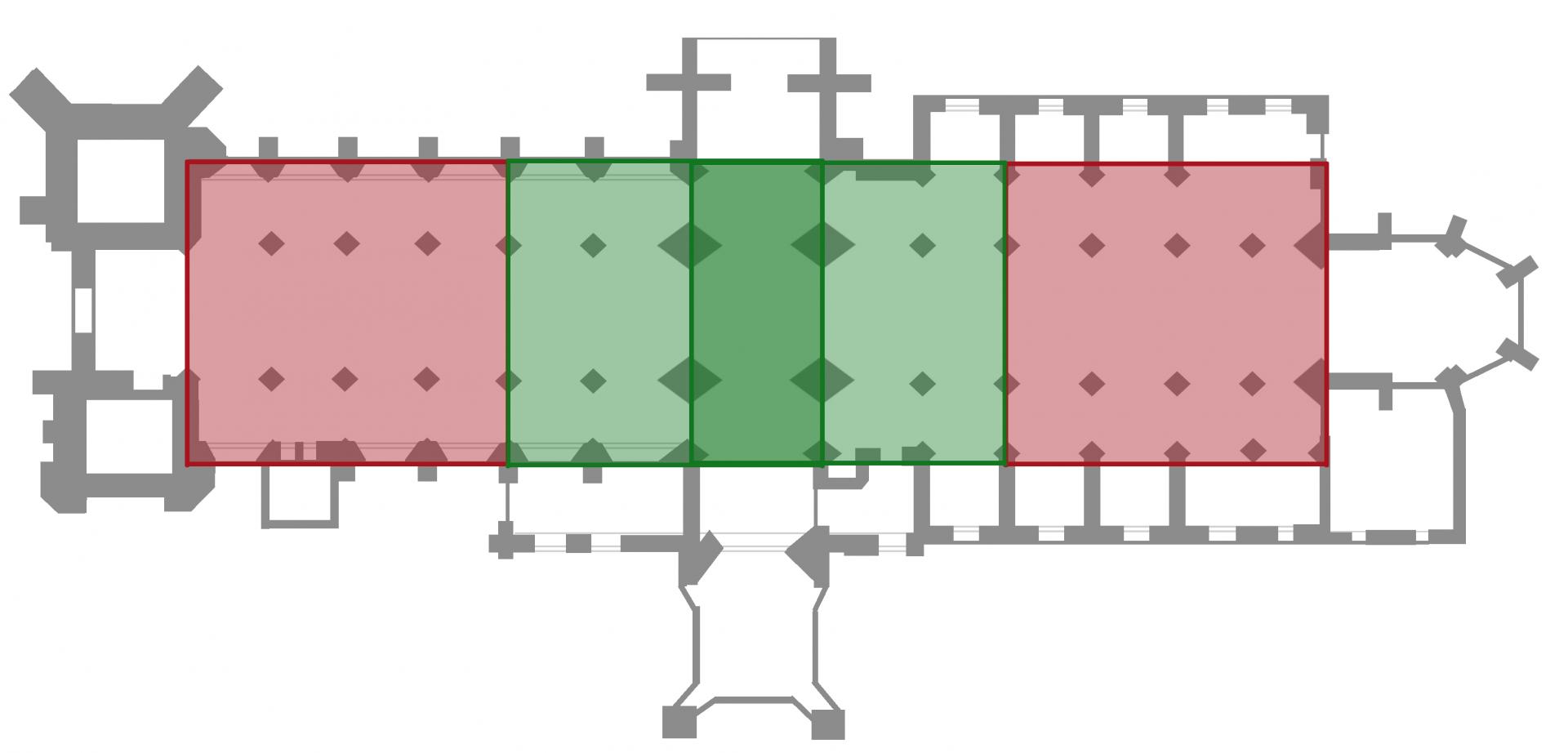
Fig. 2 - The four supposed squares
However, if we divide the overlapping squares along the lines of the transept, we can obtain three rectangles containing the golden ratio (two are formed by combining the pink and light green polygons, and the last by the two central squares). The whole is equivalent to two symmetrical constructions of a golden rectangle (like the one in Figure 1), each carried out within a double square (Fig. 3). Now, if we merge the unused spaces of the long squares, we obtain the area of the transept and the floor plan of the building.
All of this is quite elegant, and one might be led to believe that the golden ratio indeed governs the spaces of this cathedral. However, there are a number of problematic aspects to this theory.
First, the floor plan used. Here, I have roughly redrawn it for clarity, but the original (see the study) appears to be of questionable quality. This is a recurring problem that I will discuss in a few pages. Whether cause or effect, the squares used as premises are not actually squares. They are distorted and are not exactly the same size. A high-quality survey would be needed to proceed further.
The second issue is the lack of a reference framework or a working methodology. While the vertical lines of the polygons follow the centers of the pillars, the horizontal lines are aligned with the exterior wall on the left side and with the outer edges of the pillars on the right side. This is illogical and a deal-breaker. The proposed layout is therefore different from what it should be. As a result, the squares—which were not squares to begin with—are no longer squares at all, and the golden ratios disappear.

Fig. 3 - The two symmetrical golden layouts
The same is true of my attempt to redraw Figure 3, which—based on the proportions of the study—is completely misleading. To the layperson, the demonstration may seem credible, but architecturally and mathematically speaking, it is simply flawed.
Matila Ghyka would not have been troubled by these inconsistencies. He invoked “trembling” and the “trial and error of the living” to justify the discrepancy between his constructions and the plans.
The same is true of the most iconic cathedral of the Gothic style, Notre-Dame de Paris. Here, the golden ratio is supposed to appear in the proportions of the façade. No need for a blueprint; the explanation suffices: “If we divide the length (approximately 69 m) of the façade by its width (approximately 40 m), we get approximately the golden ratio (approximately 1.618) (normally, with the given dimensions, you get 1.725, but note that this result is quite close to the Golden Ratio. Be careful! You must account for the decorative elements on the towers’ roofs when calculating the height). We can conclude that the facade was built according to the rules of the Golden Ratio. ”
Note the necessity of accounting for the “ornaments” and the numerous “approximations,” which preclude any precise calculation. We cannot, therefore, assess the stated discrepancy between the expected result and the actual result.
According to the TV show “C’est pas sorcier,” the proportions of Paris’s street plan are also said to be governed by golden rectangles. It is even claimed that all cathedrals are built according to this proportion.
To demonstrate this claim, master carpenter Renaud Beyfette was called upon. Compass in hand, he is seen skillfully tracing the cathedral’s floor plan. It is a golden rectangle. The image is striking—and that is precisely the point.
The video starts right at this point >>>
Let’s set aside the fact that the structure used extends beyond the cathedral’s footprint and that, in the end, there is no correspondence with an architect’s blueprint. The troubling point is that I was unable to obtain anything other than an approximate result using this method. Moreover, we must remember that even an accurate explanation would solve nothing and explain nothing. What about the interior proportions, the construction of the transept, the rhythms of the bays, or the design of the apse? It is curious that a talented master carpenter, a specialist in medieval war machines, would propose a speculative design rather than seek a practical solution in keeping with medieval tradition.
The same observation applies to the Cistercian Abbey of Thoronet; I quote Mr. Labouret here: “By stretching the dimensions slightly, one interprets the basic module as nearly a golden rectangle. And one superimposes a number of geometric figures onto the actual plans—figures that do not even correspond to the structural points of the monument—in order to derive dimensions that support what one wishes to demonstrate…”
This is the crux of the matter. “Let no one enter here who is not a geometer,” was written on the frontispiece of Plato’s Academy. Geometry and architecture are sciences and, as such, require a minimum of knowledge and rigor—qualities that many evidently and mistakenly believe they possess.
George Jouven, chief architect of historic monuments and an undisputed specialist in arithmology, discusses the golden ratio in the 13th century. His opinion is unequivocal: “Although the drawings of Villard de Honnecourt might suggest otherwise, [the Middle Ages] had forgotten it .” Viollet-le-Duc himself, in his chapter on proportions, does not mention it at all. Clearly, the “man of cathedrals” never encountered this ratio—nor did Vitruvius, for that matter, or any other architect.
Let me clarify that my intention is not to wage war on the golden ratio—quite the contrary. My only question is whether the Gothic period was familiar with it. Based on my research, the answer is clearly no. However, some researchers may have been misled. There are constructions that are graphically very close to φ. A ratio of 5/8 yields 0.625, while a ratio of 3/5 yields 0.6. These differences are almost negligible from a practical standpoint.
Furthermore, we will see later that certain floor plans are organized around a double square—the long square—whose diagonal is the square root of five. Now, this irrational number (2.236) is nothing less than the sum of 1.618 + 0.618, or φ + 1/φ. It is quite clear that if simple squares are used, it is not to deliberately express the golden ratio; one must remain reasonable.
If one searches for it compulsively, it may also emerge from a pentagon or one of the many shapes that potentially contain it. But these are marginal results. Clearly, the golden ratio is not intended to guide a Gothic design.
As Canon Charles J. Ledit wrote: “One can always establish relationships (golden or otherwise) between any two points on the monument. A billiard ball, propelled by an undefined force, will always (thanks to the rails) end up touching the other two balls. By drawing enough lines between the points on a plan, one will always obtain indications (convincing or not).” The myth that the golden ratio was used to guide the design of Gothic cathedrals must clearly be debunked.
N.B. The appendix to the book contains additional information on Gothic proportions and the golden ratio, as well as a refutation of Professor Murray’s analysis of Amiens Cathedral.
Comments

David Orbach (Architecte - Ingénieur structure - Enseignant à l’Université Populaire de Caen de Michel Onfray)

Jean-Michel Mathonière - Directeur éditorial chez Éditions Dervy - Historien des compagnonnages

Cathédraloscope

Site : lescathedrales.wordpress.com

Jean-Pierre Bourcier - Spécialiste du trait

Olivier Petit - Médiéviste

Jean-François Lecompte - écrivain

Luciano Xavier - Maquettiste en cathédrales gothiques

Arcana Les Mystères du Monde - Youtubeur (Chaine Arcana)

troph38

Jean-François Lecompte - écrivain
John Brown

Armand Priest (ESTP) - Commentaire Facebook

Anthony CRESTIN - La géométrie et le mythe

Joël Supéry

Asso Fermat-Science

M. Moldovan

Catherine Leschenne


Dominique Gury