


Gothic Art
Every form embodies a system of thought, a conception of behaviour, a way of shaping.
Susan Condé
Gothic architecture emerged in the Île-de-France region during the 12th century. Originally, this style was called Francigenum Opus, meaning "French art". It quickly spread throughout all of Europe, lasting until the beginning of the Renaissance.
Gothic art is characterised by a vaulting system known as the ribbed vault or ogival vault. As can be seen in the drawing, it is articulated on two diagonal ribs, the ogives, which form the skeleton and support the thin infill partitions of the panels, the web cells.
The advantage of this framework is that it allows the elements of the vault to remain independent and move freely. It is thus capable of withstanding structural movements within the building.
In the Gothic system, forces follow the line of the ribs and bear directly down onto the pillars (red arrows); the remainder of the tangential forces is transmitted, via the flying buttresses, to the massive external buttresses.
These flying buttresses, which became a hallmark of Gothic architecture, were primarily intended to push the heavy buttresses to the exterior — buttresses which, until then, had condemned the building to darkness. The lateral walls being equally relieved of thrust by the wall arches, stained glass could replace stone. The book of stone was transformed into a book of glass.

Through this combined use of the pointed arch, the rib and the flying buttress, proportions and lighting could be freely modulated. From a structural point of view, each part and each element is self-sufficient and can exist independently.
Nevertheless, it remains true that the master layout proposes, and the strength of materials disposes. The builders possessed a principle, a programme, which was developed through successive refinements. At that time it was impossible to model or predict the statics of a monument; one had to experiment in order to learn. Yet, despite the evolution of techniques, the vaults evolved only in details of their components. Their principles proved fixed from the outset, and only the shape of the arches varied according to the period.
In fact, the only major structural transformation to be noted with regard to French Gothic is the substitution of the square plan in favour of the oblong plan — a term meaning longer on one side than the other. The square thus gives way to a rectangle.
A brief explanation is in order: originally, Gothic architects experimented on Romanesque buildings. They placed ribbed vaults where groin vaults and domes had previously created square structures. To achieve this, they developed a system known as the sexpartite vault. Formed by the intersection of three ogives, this vault is divided into six parts, six web cells. Figure 2 illustrates this principle. The diagonal ogives rest on four large piers known as strong piers (A), while the secondary transverse arch, used to absorb the remainder of the thrust, rests on two piers of lesser importance (B).
It will be noted that each bay of the central vessel corresponds to two bays in the side aisles. This arrangement has the disadvantage of distributing thrust unequally between strong piers (A) and weak piers (B). In practice, this feature may result in an alternating thickness of the supports.
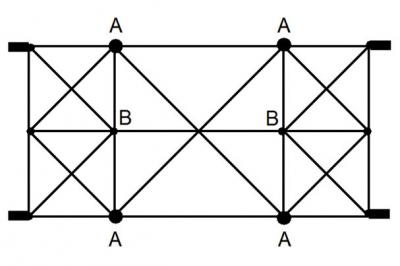
Fig. 2 - Sexpartite vault
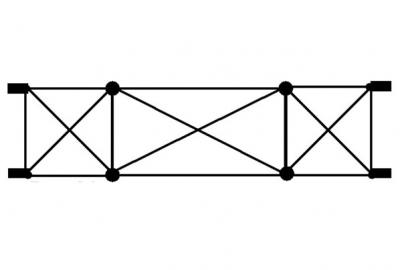
Fig. 3 - Vault on oblong plan
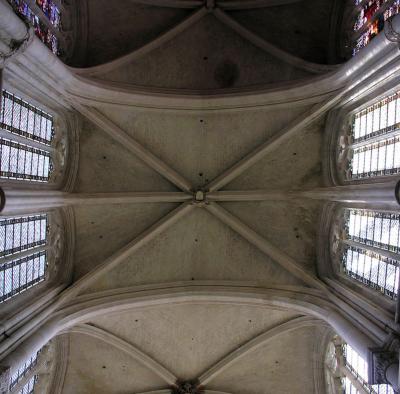
Fig. 2b - Vaults of Senlis

Fig. 3b - Vaults of Chartres
In a short time, architects became aware of the absolute flexibility of their system and its capacity to cover complex plans. From then on, they broke free from the square plan and exchanged the sexpartite vault for a quadripartite structure known as the vault on an oblong plan (fig. 3 & 3b).
The culmination of Gothic thinking, this method — combining logic and aesthetics — reduces the span of the diagonal arches and therefore the intrinsic height of the great vaults. Naturally, the alternation of strong and weak piers disappeared, and the number of bays between the naves became balanced.
In what art historians call "Transitional Gothic", one must therefore avoid conflating the refinements of an innovative concept with the improvement of an older principle, for while the methods sometimes change in form, they remain invariable in their principles. In this sense, the revolutionary nature of Gothic architecture is undeniable.
But what is the origin of the Gothic idea? From a purely architectural standpoint, asking this question amounts to determining the origin of the elements considered to define the style, namely: the pointed arch, the ribbed vault and the flying buttress.
The pointed arch can be found in certain Cluniac buildings, particularly in Burgundy, to say nothing of Norman architecture. Yet this form belongs to the common heritage of humanity, just like the discovery of the wall or fire. Thus, beyond the Middle East, India and certain Asian countries can claim to have used it.
However, no people in history had suspected its potential. It would fall solely to the Gothic genius to merge this arch with the rib, giving birth to the ribbed vault, while expressing it within a new architectural, structural and visual conception.
The origin of the flying buttress, for its part, is undisputed. This system is nothing other than an evolution of the half-barrel vault used in certain Romanesque buildings to counterbalance the thrust of the vaults.
In conclusion, the joint implementation of these techniques proves to be the expression of rational and logical thinking, of an analytical spirit of which the country of Descartes may rightly be proud, for the cradle of Gothic architecture is unquestionably the Île-de-France.
Of course, none of this happened overnight, and year by year the techniques evolved. In this regard, it is remarkable to observe the speed with which errors were corrected and solutions disseminated across all building sites. This sharing of knowledge allowed Gothic architecture to reach full maturity within just a few decades.
Comments

David Orbach (Architecte - Ingénieur structure - Enseignant à l’Université Populaire de Caen de Michel Onfray)

Jean-Michel Mathonière - Directeur éditorial chez Éditions Dervy - Historien des compagnonnages

Cathédraloscope

Site : lescathedrales.wordpress.com

Jean-Pierre Bourcier - Spécialiste du trait

Olivier Petit - Médiéviste

Jean-François Lecompte - écrivain

Luciano Xavier - Maquettiste en cathédrales gothiques

Arcana Les Mystères du Monde - Youtubeur (Chaine Arcana)

troph38

Jean-François Lecompte - écrivain
John Brown

Armand Priest (ESTP) - Commentaire Facebook

Anthony CRESTIN - La géométrie et le mythe

Joël Supéry

Asso Fermat-Science

M. Moldovan

Catherine Leschenne


Dominique Gury