


The Alphabet of Cathedrals
These four pages contain figures from the art of geometry, but anyone who wishes to know which one to use must pay close attention to understand them.
Villard de Honnecourt
It’s time to discover the geometric figures used by medieval architects. They are surprisingly simple and few in number.
To do so, I’ll start with a saying from the Bauhütte, the organization that united the stonemasons’ guilds of the Holy Roman Empire.
A point within the circle,
Which lies within the square and the triangle.
Do you know this point? All is well;
Do you not know it? All is in vain.
This riddle seems to contain, in an esoteric form, a drafting technique. It features the principal figures of Gothic drafting. So, to ensure that not everything is “in vain,” let us begin with the first line of this poem and set the point of our compass. With a single gesture, let us bring forth the circle—a spiral through time.
I have just drawn the primordial geometric figure, the genesis of all sacred architecture. Its scope is so vast that it is impossible to summarize. From the dome to the semicircular arch, including the ambulatory and the Gothic arch, the circle is embodied in every technique. Likewise, all regular shapes lie within its circumference.
Let us move on to the second verse: “The point is placed within the triangle,” a figure that, for Viollet-le-Duc, is “entirely satisfactory, perfect, in that it conveys the most precise idea of stability. ”
When it forms a right angle, it is a rectangle and is associated with the square. On the construction site, the craftsmen create it using a cord marked with knots. This cord, also known as the druids’ cord or Egyptian cord, is divided into twelve equal sections by thirteen knots, each representing one cubit. Think of it as a surveyor’s chain.
Take, for example, the so-called “Pythagorean” triangle. Consisting of one side of 3 units, another of 4, and a hypotenuse of 5, it forms a right triangle—the first to be generated by an arithmetic sequence. We can see that it allows us to establish axes and create a grid. This process lies at the origin of all work and justifies the special place of the square among the symbols used by masonry guilds and craft guilds. A straightedge and compass can be used in place of this instrument. Thus, given a simple straight line, one need only draw two symmetrical arcs to trace a perpendicular bisector. By connecting these three points, we obtain an equilateral triangle. This triangle, familiar to all schoolchildren, will allow me to introduce the methods for drawing Gothic arches. Indeed, not content with taking pride of place at the center of cathedrals, the equilateral triangle enables us to draw the rib vaults known as “tiers-points.”
To do this, we must study the various types of arches used by medieval builders. In his notebook, Villard de Honnecourt shows us how to draw them using a single compass setting (Fig. 3a).

Fig. 3a - Drawings of pointed arches (Villard de Honnecourt - folio 41)
First, we see a semicircular arch (fig. 3b). It is formed by a simple semicircle (the dot marks the origin of the arc). This figure requires no explanation. Second (Fig. 3c), we find a pointed arch based on a line divided into three parts. In Figure 3d, we see the famous “tiers-point” that I just mentioned. When connected, the points of the drawing form an equilateral triangle.

Fig. 3b - Round arch

Fig. 3c - Ogival arch
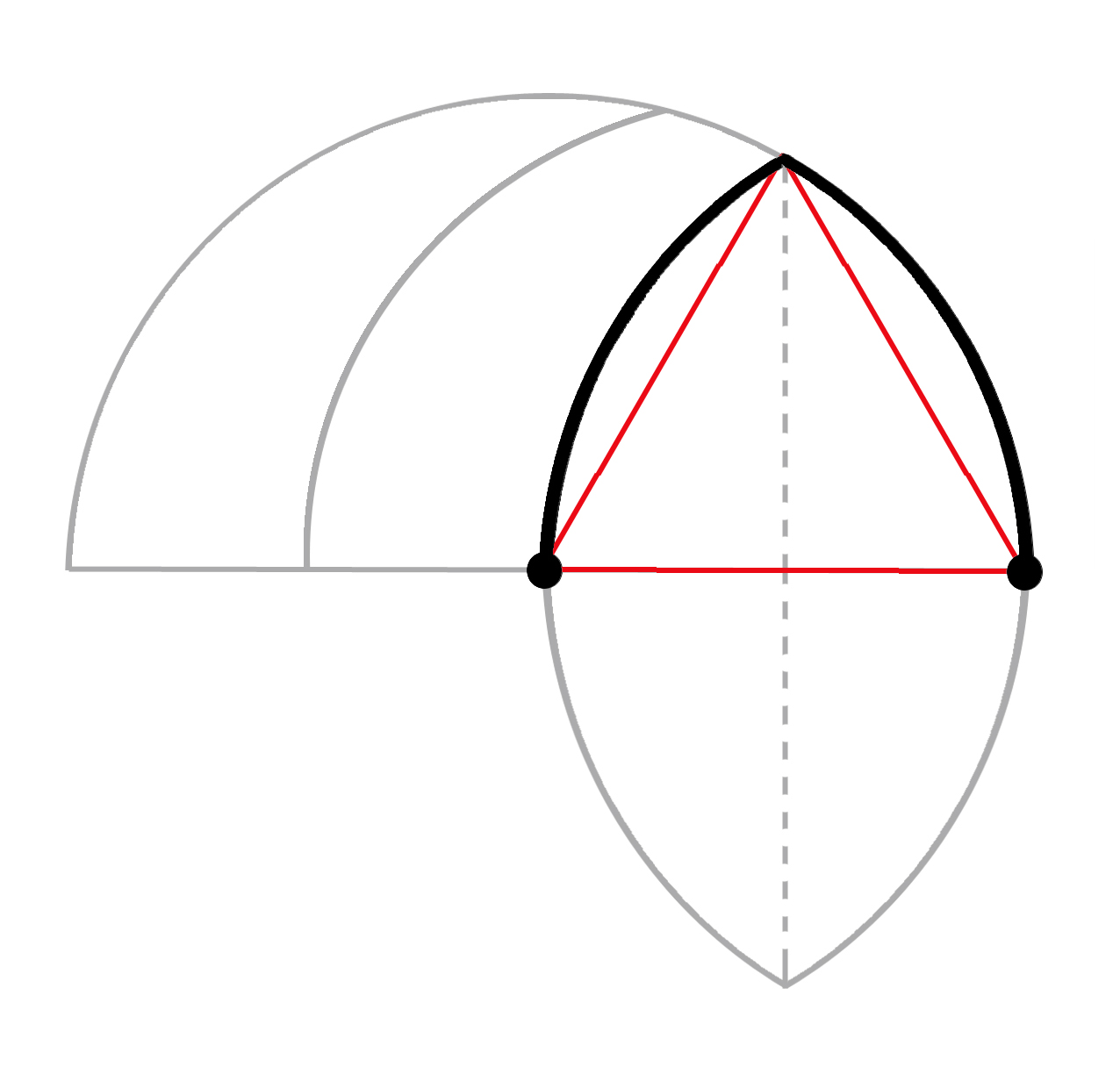
Fig. 3d - Third-point arch
Note: The points mark the origins of the arcs of a circle.
Following the same principle, the line could have been divided into three, four, or five points to define arches with different openings. Interested readers can find further information on vault designs in the Geometry Appendix (1).
The triangle, like all polygons, gives rise to a governing rectangle—that is, the initial form of a geometric design, its very nature. I will use an example that we will return to shortly: the transept crossing of Reims Cathedral (Fig. 4a). If we draw an arc between the two lower columns, we see that the arc intersects both the vertical median axis and the line defined by the transverse arch (Fig. 4b). If we connect these three points, we obtain an equilateral triangle (Fig. 4c). Finally, we can construct a rectangle around its vertices (Fig. 4d).

Fig. 4a

Fig. 4b

Fig. 4c

Fig. 4d
Here we are guided by the drawing on the plan, but if we were to reproduce this construction directly on a blank sheet of paper, we would obtain the same result, the same proportions. This is what I call retracing.
“The point is placed within the square.” With its stable form, the square is capable of indicating the cardinal directions, the four elements, and the four seasons. Thus, the cathedral rises from the square of the earth, which itself derives from the square of the sky. The connection between this figure and architecture is self-evident; it is omnipresent.
Let’s return to the example from the previous chapter devoted to the analysis of a nave. The result revealed a structure based on the diagonal of a square. Instead of a square, I could have chosen a triangle or any other combination of these shapes (Fig. 5). Ultimately, the combination of these shapes forms a polygon upon which one of the vault designs we have just studied is directly constructed.

Fig. 5 - Elevations constructed using squares and triangles
Note, on the right side of Fig. 5, the method for transferring two-thirds of a line’s width (Fig. 6a). This proportion is equivalent to that of a triangle in which the legs measure three and two units, respectively (Fig. 6b).
Now, if we double this two-thirds transfer, we obtain a side of 4 on a base that remains 3, which are the proportions of the Pythagorean triangle.

Fig. 6a - 2/3 of a width shifted

Fig. 6b - Equivalent 3/2 triangle
Following the same principle, it is clear that other triangles can be used to construct a regular polygon. As we can see, the elevation is always determined by simple geometric ratios.
Comments

David Orbach (Architecte - Ingénieur structure - Enseignant à l’Université Populaire de Caen de Michel Onfray)

Jean-Michel Mathonière - Directeur éditorial chez Éditions Dervy - Historien des compagnonnages

Cathédraloscope

Site : lescathedrales.wordpress.com

Jean-Pierre Bourcier - Spécialiste du trait

Olivier Petit - Médiéviste

Jean-François Lecompte - écrivain

Luciano Xavier - Maquettiste en cathédrales gothiques

Arcana Les Mystères du Monde - Youtubeur (Chaine Arcana)

troph38

Jean-François Lecompte - écrivain
John Brown

Armand Priest (ESTP) - Commentaire Facebook

Anthony CRESTIN - La géométrie et le mythe

Joël Supéry

Asso Fermat-Science

M. Moldovan

Catherine Leschenne




Dominique Gury