


Elevation of Bourges Cathedral
the archaeology of the Middle Ages should not be confused with the philosophy of art, which is sometimes taken as a model and sometimes proposed as an end.
History and its methods
In the preceding pages, we have skimmed over the ground plans, but these are only one aspect of the problem. They are but the shadow of immense structures stretching skywards. They are both the indirect consequence and the primary cause. In Aristotle's sense, the two are mutually architectonic. So let's be curious and turn our attention to the elevations, which are unquestionably part of the purest of geometries.
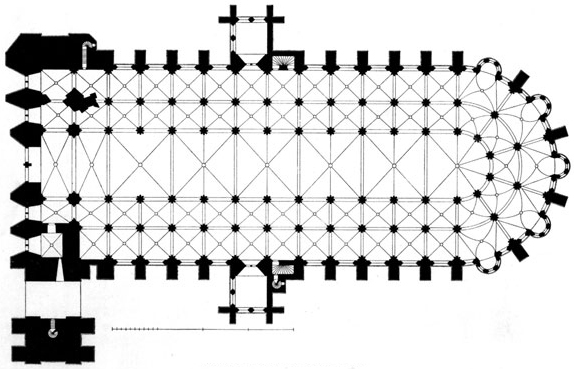
floor plan of Bourges Cathedral
The first cathedral encountered on this site was at Bourges. Now's the time to discover its secrets and put into practice what we've learned in Chartres (the Chartres study is included in the book). The plan in figure 1 is a laser scan, an elevated section of the nave of Bourges. You can see that the floor plan enclosures have been projected vertically. These lines determine the layout of the cathedral's volumes: central nave, aisles and side aisles.

Fig. 1 - Elevation of Bourges Cathedral
Let's start by determining the origin of the vault. To do this, I've superimposed two equilateral triangles (fig. 2). As you can see, the procedure is identical to that used to find the profile of Chartres. The fact that the same layout can be used to determine both structure and profile is instructive. It teaches us that design procedures were common to all Gothic builders, and that they were universal in scope. Clearly, medieval master builders belonged to the same school, the same initiation.

Fig. 2 - Elevation of Bourges Cathedral (stage 1)
Let's move on to the analysis of the interior profiles. As can be seen in Fig. 3, the design of the central nave is a long square (double square), as in many cathedrals. The vault is traced by a line divided into five parts. We have already studied this process.

Fig. 3 - Elevation of Bourges Cathedral (stage 2)
We now have the cathedral's interior volumes and layout. The following plate brings these systems together (fig. 4). We understand that they are the two complementary aspects of the monument's design: the structure and the interior profiles. The lines of the polygons used juxtapose and merge. This layout is a true masterpiece.
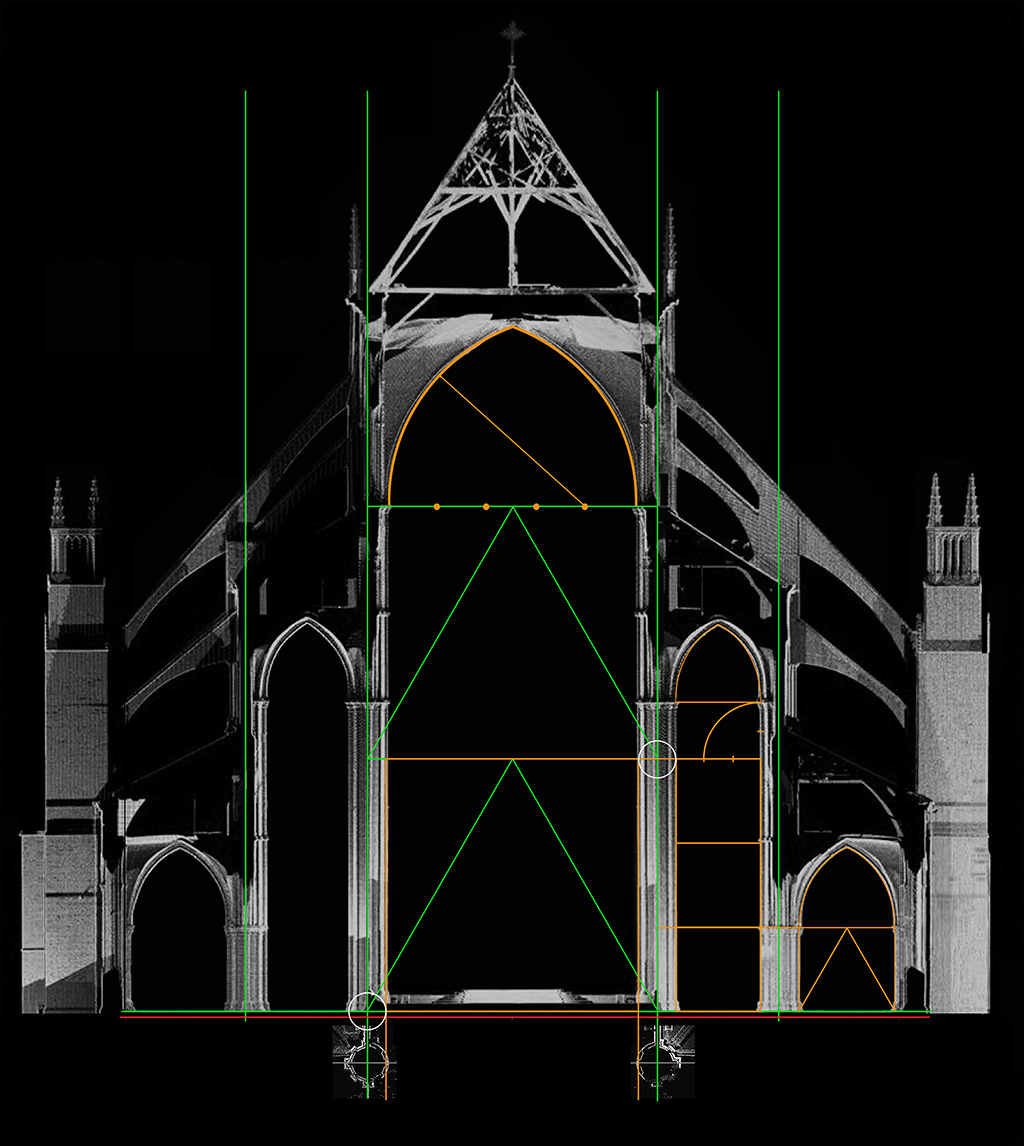
Fig. 4 - Elevation of Bourges Cathedral (stage 3)
Without the landmarks provided by the triple enclosure, we wouldn't know how to place the volumes in relation to each other. It's the role of the segments to simplify this construction. But in practice, how did the architect go from the first system to the second? There has to be a common value, a link that unites them. We have seen that the height of the central vessel plays this role. Once determined using the procedure in fig. 2, this height is divided by two to form the two superimposed squares of the central vessel (fig. 3).
The side aisles are made up of three superimposed squares, topped by a new 2/3 ratio. The vaulting is in tiers-point (on an equilateral triangle), as are those of the aisles. The height of the side aisles is aligned with the first square of the side aisles.
It's important to understand that the horizontal difference between the green line (the layout) and the yellow line (the profile) is equal to half the width of the fixtures and piers. Nothing could be easier than to determine the latter. This relationship is represented by the white circle. The elevation is now traced. The rest of the structures, buttresses and other fixtures are calculated on a point-by-point basis.
Credits: The scan in figure 1 comes from a document provided by Andrew Tallon to Professor Robert Bork for his article The Geometry of Bourges Cathedral, licensed under CC BY 3.0. Here, the scan has been turned negative to enhance legibility.
Commentaires

David Orbach (Architecte - Ingénieur structure - Enseignant à l’Université Populaire de Caen de Michel Onfray)

Jean-Michel Mathonière - Directeur éditorial chez Éditions Dervy - Historien des compagnonnages

Cathédraloscope

Site : lescathedrales.wordpress.com

Jean-Pierre Bourcier - Spécialiste du trait

Olivier Petit - Médiéviste

Jean-François Lecompte - écrivain

Luciano Xavier - Maquettiste en cathédrales gothiques

Arcana Les Mystères du Monde - Youtubeur (Chaine Arcana)

troph38

Jean-François Lecompte - écrivain
John Brown

Armand Priest (ESTP) - Commentaire Facebook

Anthony CRESTIN - La géométrie et le mythe

Joël Supéry - Site tuskaland.com

Asso Fermat-Science

M. Moldovan

Catherine Leschenne




Dominique Gury