


The following study was carried out by J.P. Bourcier after reading the book Les clés de Vézelay.
The intention is to verify the plausibility of the proposed routes.
Contrary to the sequence given in the book, in which the Gothic
the Gothic crossing from the pre-existing Romanesque nave, Mr. Bourcier
backwards, i.e. from the crossing to the nave
nave.
This approach reverses the direction of geometric progressions
geometrical progressions, thus highlighting any discrepancies.
For those who haven't read the book, I feel obliged to provide an explanation, without which the following exercise would remain obscure. The nave of Vézelay was built well before the transept crossing. It has 10 bays geometrically formed by equilateral triangles placed head to tail.

The crossing, on the other hand, is made up of two squares adjoining two equilateral triangles. In fact, in Gothic buildings, the crosspiece often takes the form of an equilateral triangle, whereas Romanesque crosspieces tend to be square. Given that these two types of architecture coexist in the basilica, it's clear that the upper part of the Table (based on triangles) was designed to govern the Gothic ensemble, while the lower part (based on squares) was tasked with taking the Romanesque nave into account.
The red segment you can see on the right-hand panel thus takes into account the proportions of the nave's bays. Thanks to this extraordinary geometric property, the architect of Vézelay was able to integrate the rhythm of the Romanesque nave into his design (see the Vézelay Tables system).
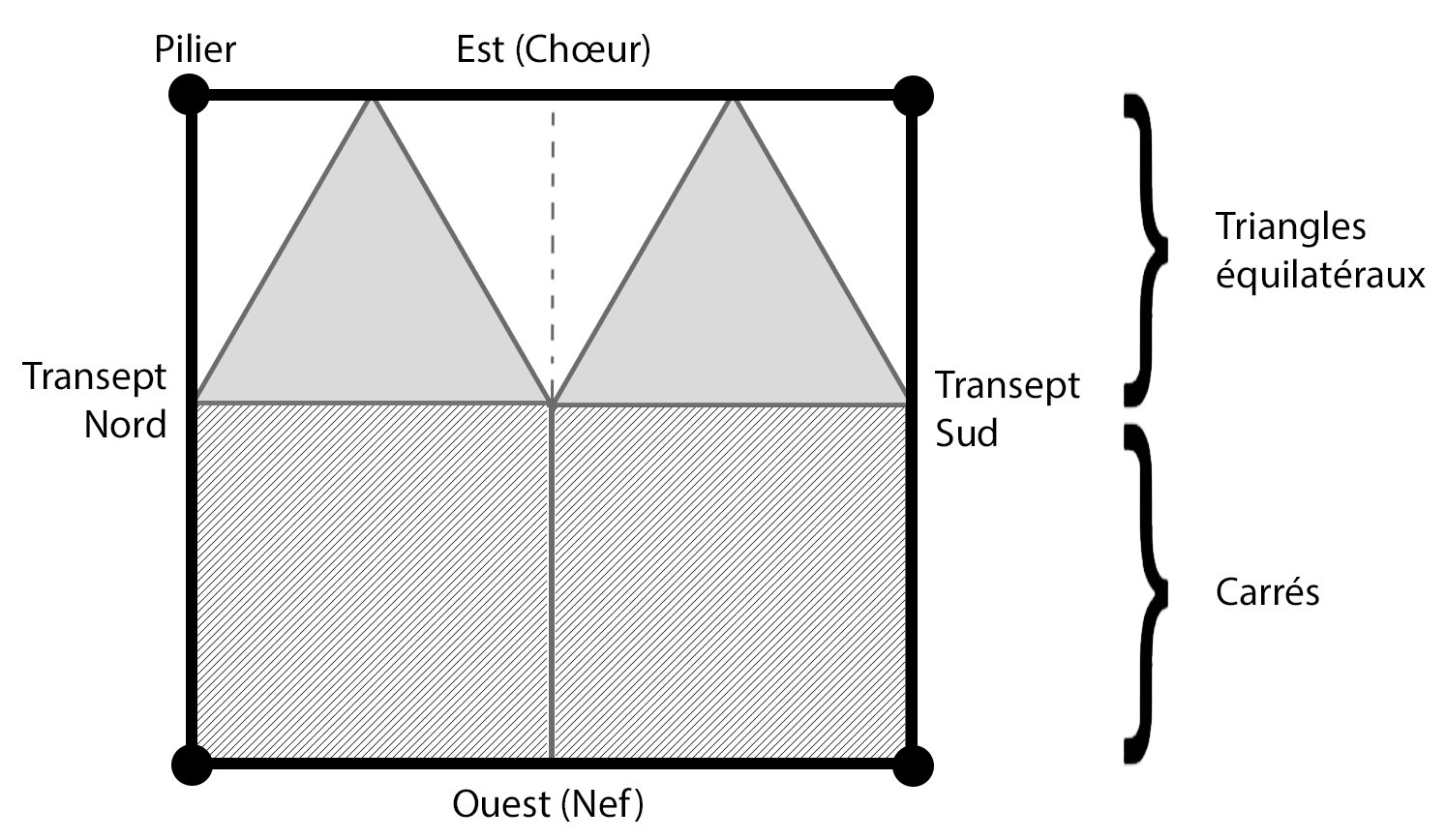
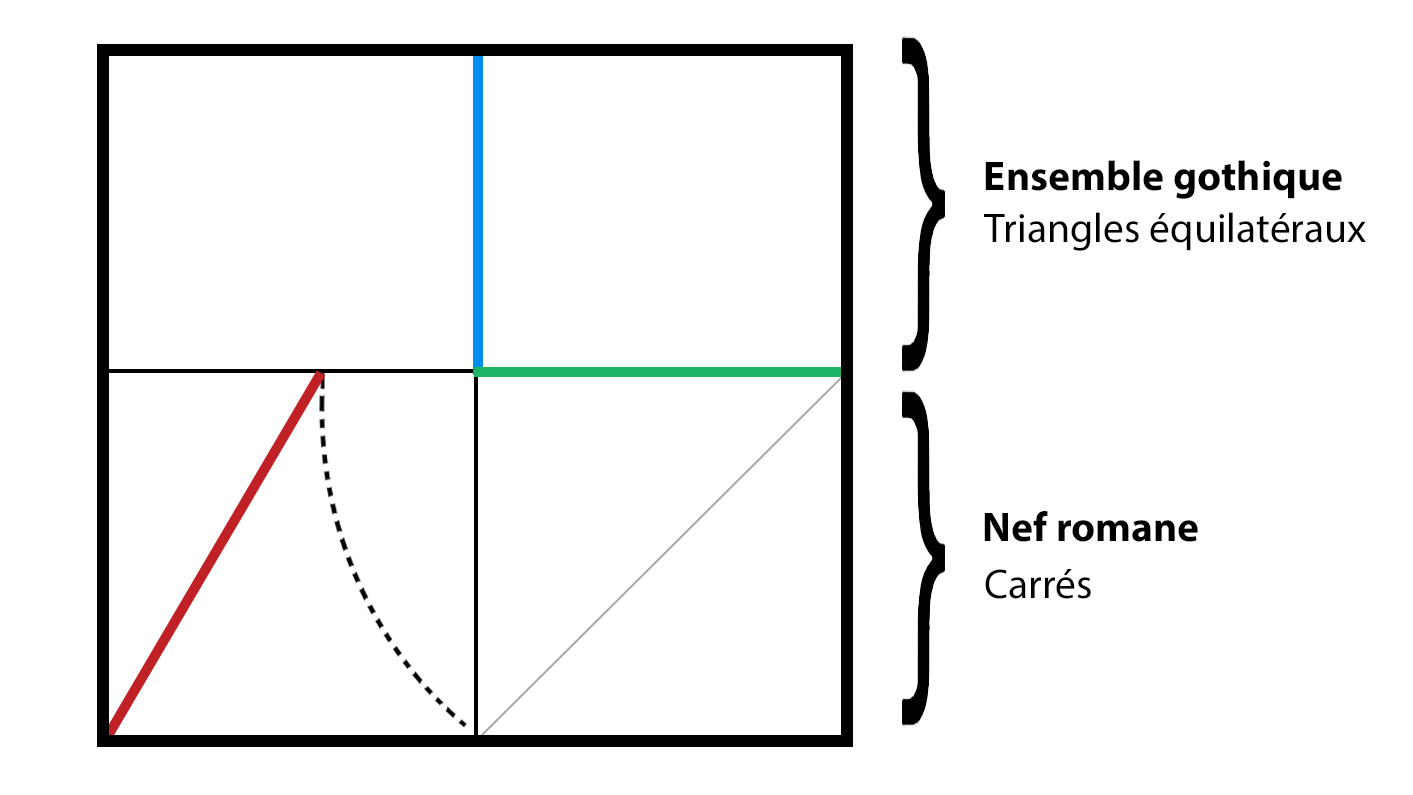
Basilica plan from Les clés de Vézelay.
Jean Pierre Bourcier - Budapest July 5, 2019
Since the dawn of time, every blueprint has begun in the same way. A square line is drawn to define two reference axes. So let's suppose that the square line 11 - 22 with center O is drawn. On 11 is carried on either side of O the ½ width of the span in OA and OB; the circle of radius OA is drawn, it intersects 22 in N. The intersection of two arcs of circles of radius OA and center A and N and the intersection of two arcs of circles of radius OA and center B and N define points C and D.
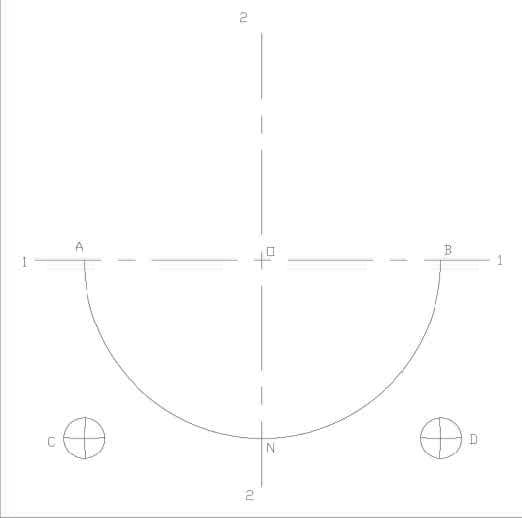
The intersection of two arcs of circles of radius OA with centers A and O and the intersection of two arcs of circles of the same radius with centers O and B define points E and F.

The table can now be drawn.

The arc with center B and radius BG is drawn, intersecting 11 at G1; the segment CG1 is drawn, defining the width of the nave bay.

The arc of a circle with center C and radius CG1 is drawn, intersecting axis 22 at G3 and the extension of AC at G2.

The triangle CG3G2 is not equilateral, as the perpendicular lowered from G3 to CG2 does not pass through the middle M of CG2. The deviation in position of the vertex for a span width of 10 m is 31mm along axis 22, which is totally negligible in relation to the dimensions of the building and the staking tools used.

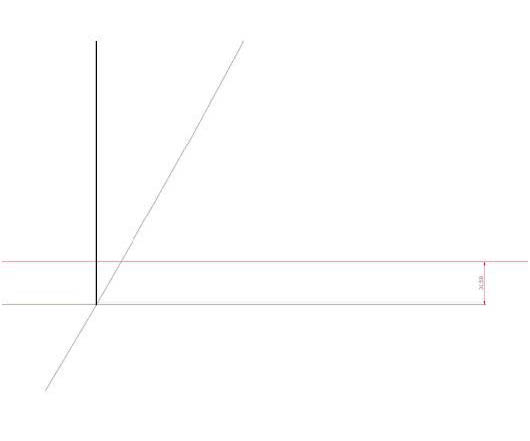
This deviation is comparable to that found when tracing the polygon of the choir. Here, the emphasis is not on the mathematical accuracy of the tracing, but on its simplicity, as the deviation is only perceptible to the initiated.
Transferring the AH segment to AH1 and H1H2, and drawing it symmetrically with respect to 22, defines the second and third enclosures along direction 11.
Transferring the segment JK to JK1 and K1K2, and drawing it symmetrically with respect to 11, defines the second and third enclosures in direction 22.

The nave and choir bays can then be traced from this line. Villard's routine is applied to bay n, enabling the choir to be traced completely.

This results in the following breakdown:

All that remains is to trace the narthex, as shown in figure 5, which presents an ambiguity, as the length of the rectangle is different from the length of the rectangle in figure 6, which is the bay width; in relation to the given plan of the basilica, the narthex and nave bay widths are identical. On the other hand, it is specified that the architect at work goes to the other side of the nave aisle to make his layout. The width of the narthex bay is therefore slightly greater than the width of the nave bay, which seems to be borne out by the plan.

All these layouts are perfectly realistic, using simple geometric shapes - squares and triangles - that are easy to draw. The number of compass openings is three, and only two angles are used: 45° and 60° (or its complement 30°), which are easy to memorize.
It's hardly necessary to point out that, until the end of the 19th century, many layouts were the subject of routines that were memorized and didn't require workers to know how to demonstrate them, so that they could be used simply. A good example of this are the routines in the woodworker's booklet.
And the golden ratio? The best way to find out is to send an SMS to Nicolas Flamel, with a copy to the Comte de St-Germain.
Cathedrals retraced

The keys to Vézelay

Commentaires

David Orbach (Architecte - Ingénieur structure - Enseignant à l’Université Populaire de Caen de Michel Onfray)

Jean-Michel Mathonière - Directeur éditorial chez Éditions Dervy - Historien des compagnonnages

Cathédraloscope

Site : lescathedrales.wordpress.com

Jean-Pierre Bourcier - Spécialiste du trait

Olivier Petit - Médiéviste

Jean-François Lecompte - écrivain

Luciano Xavier - Maquettiste en cathédrales gothiques

Arcana Les Mystères du Monde - Youtubeur (Chaine Arcana)

troph38

Jean-François Lecompte - écrivain
John Brown

Armand Priest (ESTP) - Commentaire Facebook

Anthony CRESTIN - La géométrie et le mythe

Joël Supéry - Site tuskaland.com

Asso Fermat-Science

M. Moldovan

Catherine Leschenne




Dominique Gury